crazy crazing
Where clay and glaze disagree
Sometimes, the lines are easily spotted but sometimes it requires some close up and squinting. Have you ever noticed the cracks on your pottery product at home? Have you ever since pottery pieces with lots of fine cracking lines?
Crazing is a defect detected by the network of fine cracks on the surface of a glazed pottery product. Most of the time, it does not mean the piece is falling apart, the lines could be shallow or decorative. This effect may occur during the cooling step inside the kiln, after firing and before removing the pieces from the kiln; however, the stress might be contained thanks to the strength and elasticity of the glaze so crazing is not too serious at this stage. But later on, during the day-to-day use, the expansion and contraction worsen the situation, hence the crack will be more prominent. There is an explanation for this, a mismatch in the thermal expansion between clay and glaze, in other words, how sensitive each of the clay and glaze is to outside temperature is different from each other.
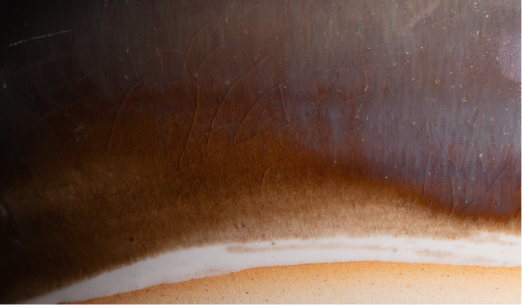
Imagine you grow bigger than your clothes and it tears, imagine when you use an oversized paper to wrap such a small stuff, it wrinkles. When the outer layer and the inside do not fit, there is a flaw; in this case, since the clay body and its coat - glaze - stretch out and tighten at different levels towards the heat and coldness, cracks appear. Specifically, porous bodies like earthenware keep absorbing moisture from the air and expand non stop but it is met by the stiff layer of glaze outside that does not do the same thing, hence the glaze has no choice but to craze as a coping mechanism to the tension put on it.
How bad could crazing be? If it is on tableware that we use to eat and drink everyday, it is unhygienic as the cracking lines introduce mold, potential bacteria to our cup, bowl, dish, etc…, and accumulate stains gradually. Overall, crazing weakens the structure integrity of the pottery piece, eventually leading it to fall apart. It is a quiet and slow process.
Wait, but there are some pottery goods that were made deliberately with the cracking lines!
Yes, then in that case, instead of crazing, the name would be crackles or craquelle, indicating that the crazing effect is intentional and everything is under control, the potter knows what they were doing with it. Briefly, the crazing effect is now introduced to the glaze by adding Alkali oxides like KNaO, or either underfired or overfired the piece; all is done with careful calculation and planning. The result will be beautiful lines, sometimes with stain or colourant rubbed into the cracks even, that boost the artistic value of the piece to a higher level. In that saying, the crackle is still not food-safe to use in food and beverage consumption, mostly for decorative pieces. Exemptions could be possible when the potters already took care of the clay body by fully vitrifying it or when crackle glaze is tested on specific type of clay, but still, better be safe than sorry.
Generally speaking, crazing is the consequence of thermal expansion mismatch between body and glaze. It could be right at the cooling step of the firing process or overtime when the piece is exposed to thermal shock. Craze with intention is called crackle and it is a league of its own. Crazing is not food safe, recommended for decorative products only unless the potter is very certain at what they were doing and carefully did all the due diligence of testing it.